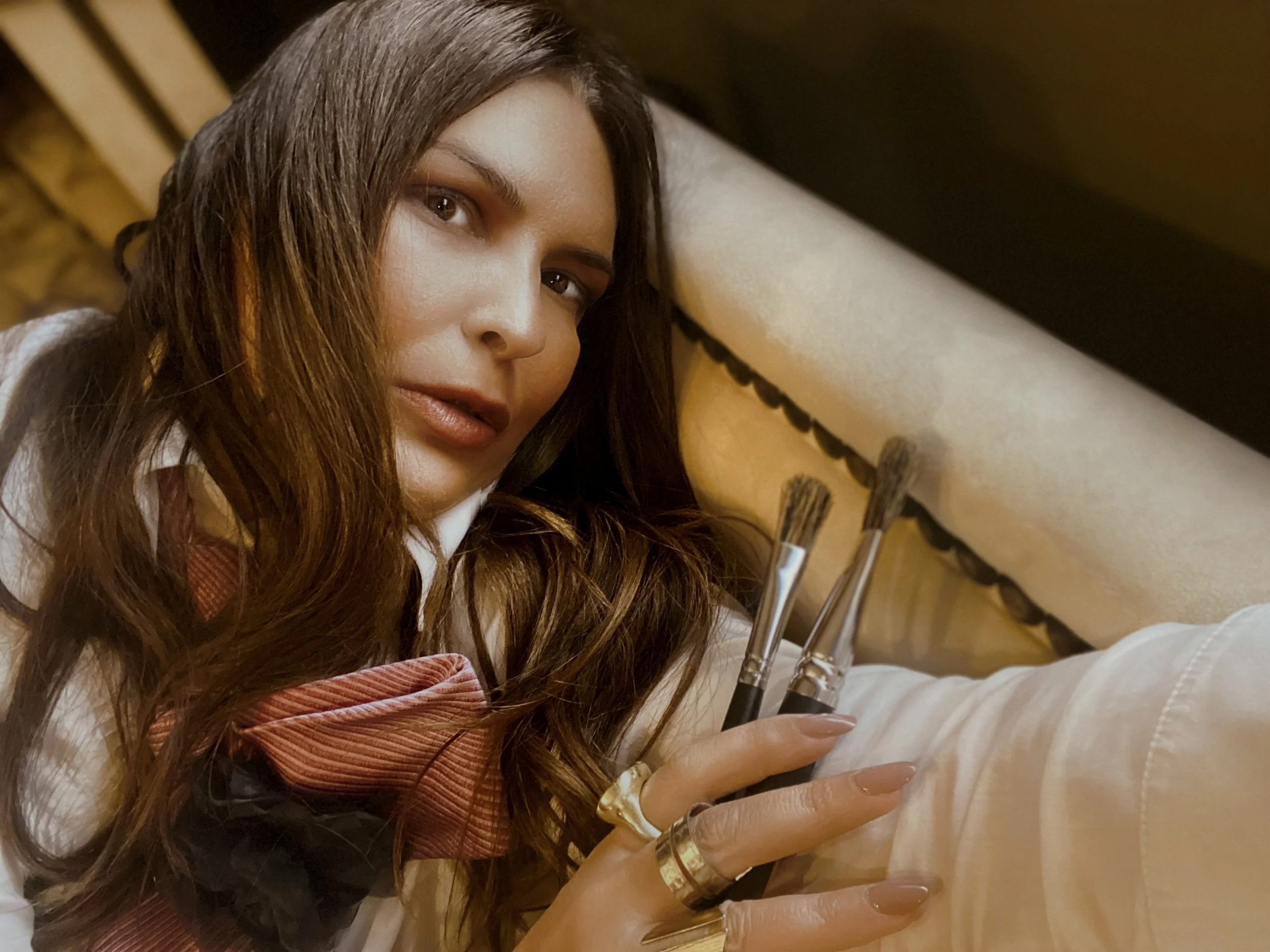
ANNITA A. – A JOURNEY THROUGH ART AND SOUL
From the moment I could hold a pencil, art became my language. My world. My breath.
I was five when I “borrowed” a pencil from my grandmother and turned the walls of our home into a fairy tale. I still remember my mother’s stunned expression — a mix of horror and wonder. That moment etched itself into memory, and soon after, I found myself inside the studio of the painter Dimitris Kantopoulos. Among towering easels and awestruck art students, I stood small but certain — the youngest presence in the School of Fine Arts. I was offered not just lessons, but magic. I never looked back.
At eight years old, I painted in a sea of older students. The smell of paint, the palette of infinite color, the quiet rhythm of brush against canvas — it became my haven. My mentor once told me, “Even if not everyone understands your work, they will remember your colors — your true magic.” That promise became a thread I have followed ever since.
When allergies took me away from oil paints and turpentine, my path twisted — but never broke. I turned toward Fashion Design, chasing the fire in my soul instead of the “sensible” path of Business Studies. At Veloudakis Fashion School in Athens, I found new textures for my creativity — cloth instead of canvas, thread instead of brushstroke. Fashion and history danced together, and I danced with them.
Every new creation was a breath. I soaked up knowledge like sunlight — in long nights, hands busy, heart open. This was more than a skill. It was a calling.
But my heart still craved more. I studied Jewelry Design at YWCA School of Arts in Athens, and that spark sent me to Paris — to the runways, the ateliers, the quiet hum of Montmartre. Art lived in every window, every shadow, every glance. I felt it inside me — stirring again.
Italy called me next — not just as a destination, but as a resonance. Its palette of moody greys and golden frescoes felt like home. Milan became my home, as I immersed myself in the Instituto Artistico dell’Abbigliamento Marangoni. I graduated with an Advanced Diploma in Fashion, a Master’s in Jewelry Design & Accessories, and Interior Design courses that shaped the aesthetic backbone of my visual language.
Versace offered me a future. I had the diplomas, the letters of recommendation, the spark. But my life took me back to Greece — with determination instead of regret.
And there, in Athens, I walked into the atelier of Haris Hourmouzis in March 1994. It was the day before the Fall/Winter Fashion Show. The atelier was electric — threads flying, heels clacking, silence charged with vision. Haris asked me, “Do you have a strong stomach?” My yes was quiet, but it was absolute. Our collaboration would become a golden chapter in my life.
As a designer at Harris & Aggelos, I lived in creativity. We traveled for shows. We worked under pressure. We laughed. We triumphed. We created. And through it all, I discovered not just fashion — but myself.
In 1998, sculptor Nikos Giorgos Papoutsidis entrusted me with his exhibition narration. This collaboration gifted me not just recognition, but friendship. In 1999, I dove into the Volkswagen “Beetle Art” Contest, where my work “Millennium” was exhibited at the Glyfada Golf Club — and embraced by the public.
I was reaching artistic peaks. And yet, I chose something rarer: stillness. I stepped away from fashion in 2000, seeking my own rhythm. A different joy.
I founded Annita Platis Collections in 2001 — a blend of decor, art, and design from Florence and Venice. In 2007, I created All My Life, a wedding & event company full of handmade details, emotions, and beauty. But in 2010, life whispered, “Pause.”
And I listened.
Until one voice — beloved and honest — reminded me in 2016:
“You cannot deny your nature. You are born for art. You are Art.”
That moment ignited the fire once more.
The series Faces & Characters (2016–2018) marked this return. Comprising eighteen works developed over two years, and integrating acrylic, charcoal, aging techniques, and digital media, the series became a threshold between past and present. Its complete acquisition by an Italian collector for installation in villas in Portofino—prior to public exhibition—affirmed not only its reception, but also the urgency of continuation.
What followed was not a linear progression, but an unfolding.
My Soul Kingdom (2018) emerged as an inward descent—dark grounds, symbolic figures, and poetic texts forming a private cosmology. Eternal Lover (2019) extended this into a more fluid, emotional terrain, where femininity, nature, and surreal presence intertwined. During the stillness of 2020, narrative expanded into writing, where image and text began to coexist as parallel forms of expression.
In 2020, I wrote my first fairy tale, The Princess and the Red Goldfish, presented alongside visual works in Fairytales & Paintings, further extending the dialogue between image and narrative.
Later that year, Camouflage (2020) explored concealment and revelation—how identity is constructed through layers, masks, and subtle distortions. In Words (2022), abstraction entered my practice more explicitly, reducing image to gesture, rhythm, and symbolic residue.
Links (2023) introduced a more structured engagement with digital collage, where memory, fragmentation, and connection became central. Here, the female form operates not as subject, but as a site of continuity—linking past and present, material and digital, personal and archetypal.
In Legends: The Code (2024), mythology became a framework for reinterpreting feminine archetypes. These figures do not belong to history alone; they are reactivated and translated into a contemporary visual language, carrying forward narratives that remain unresolved.
Subsequent series—The Seasons – Special Edition, The Era Clockmakers, and The Luminous Abyss—extend this investigation into time, transformation, and perception. Across these works, light and darkness are not opposites, but coexisting states; the visible becomes a threshold for what remains internal.
In parallel, I expanded my engagement with exhibition-making and curatorial frameworks, deepening my understanding of how artworks function within spatial, conceptual, and institutional contexts.
My body of work, When Color Knows the Script (2025-2026), represents a further distillation of these concerns. Developed over several years, it approaches color as an autonomous intelligence—capable of structuring narrative without reliance on explicit form. Composition becomes quieter, more restrained, allowing meaning to emerge through subtle shifts, tensions, and intervals.
With Rugs & Reverence (2025–2026), I return to material memory through a visual language rooted in ornament and devotion. This body of work unfolds as a homage to the narrative power of textiles, where rugs become vessels of story—expanding into worlds of animals, jewels, garments, and symbolic objects. The series is structured in two interconnected realms—Creatures of Memory and Objects of Devotion—unified by a shared aesthetic and conceptual framework. In many ways, this work continues and evolves the symbolic lineage first explored in My Soul Kingdom.
In 2026, this ongoing dialogue between image and text extended beyond the canvas into publication. With Legends – The Code, I translated this evolving practice into a structured artist monograph, where visual works and written reflections coexist as a unified narrative system. The book does not document the work—it rearticulates it, allowing image and language to operate as parallel forms of meaning.
Throughout my practice, I work in series, understanding each as an evolving system rather than a fixed statement. Recurring symbols, figures, and chromatic structures form a visual lexicon that unfolds over time. The work resists immediate resolution, inviting instead a sustained engagement with ambiguity.
Art, for me, is not an object but a field of experience.
It is a space where memory, intuition, and perception intersect—where the visible carries what cannot be spoken directly. Each work is not a conclusion, but a passage: between interior and exterior, image and thought, presence and absence.
I do not seek to illustrate the world as it appears, but to reveal the structures beneath it.
To work with color as language.
With form as memory.
With image as a threshold.
This is my practice.
This is my way of seeing.
Annita Apostolidou Platis