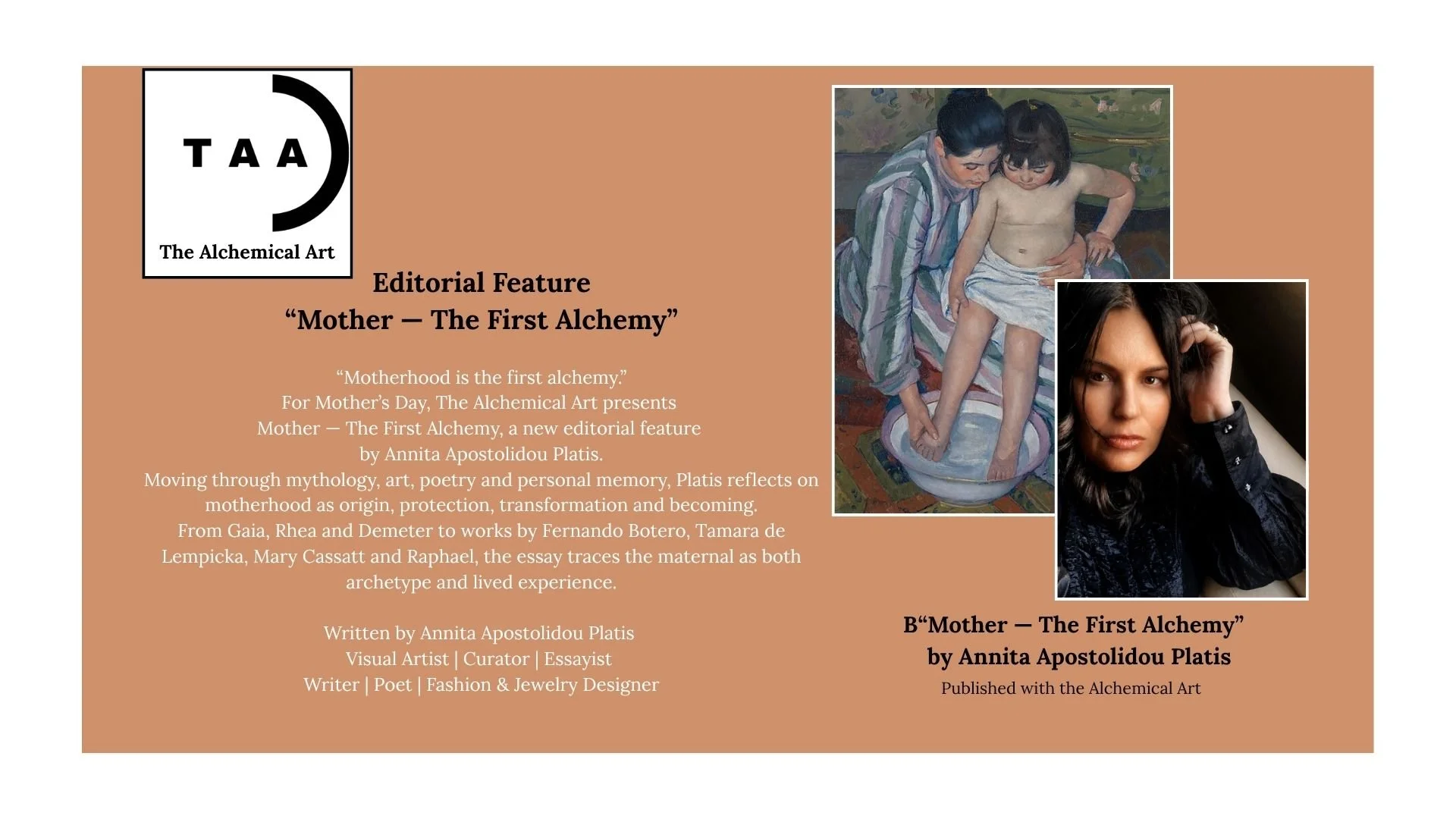
Mother — The First Alchemy – Curatorial Essay | Annita Apostolidou Platis
Mother — The First Alchemy is a curatorial essay reflecting on motherhood as the first and most profound form of transformation. Moving through mythology, art history, poetry, and personal memory, the text explores the maternal presence as origin, protection, wisdom, release, and becoming..
Published with The Alchemical Art
Mother — The First Alchemy is a curatorial essay reflecting on motherhood as the first and most profound form of transformation.
Through mythology, art history, poetry, and personal memory, the text approaches the maternal presence not only as the beginning of life, but as the beginning of perception, emotional formation, protection, release, and becoming. From Gaia, Rhea, and Demeter to works by Fernando Botero, Tamara de Lempicka, Mary Cassatt, and Raphael, the essay traces motherhood as an archetypal and deeply human force — one that shapes the first architecture of the self.
Written as both a curatorial reflection and a personal tribute, Mother — The First Alchemy becomes a meditation on origin, love, wisdom, and the invisible maps passed from one generation to another.
Publishing Mother — The First Alchemy with The Alchemical Art marks an important extension of my artistic practice.
My work has always explored symbolism, transformation, feminine identity, mythology, and interior states through visual language. Writing allows this same inquiry to unfold through another medium — one that gives space to reflection, interpretation, and curatorial thought.
For me, writing is not separate from my art. It is another form of image-making.
This collaboration reflects a growing dialogue between contemporary art, curatorial writing, and artistic authorship, where artists are not only creators of images, but also contributors to critical and poetic discourse.
I am grateful to The Alchemical Art for the thoughtful editorial integration of this piece and for cultivating a platform where art and philosophy can meet.
Read the full editorial feature published with the Alchemical Art:
Mother — The First Alchemy
Annita Apostolidou Platis
Visual Artist · Curator · Essayist · Fashion & Jewelry Designer
© 2026 Annita Apostolidou Platis. All rights reserved.

About Canvas & Art
From its ancient Greek origins to the Renaissance masters, canvas has long been the fabric of artistic legacy. Learn about its evolution and enduring role in art.
Annita Apostolidou Platis
Canvas is an extremely durable, plain-woven fabric. Usually made from cotton, linen or hemp, it’s popular as a painting surface when stretched across a wooden frame (called a ‘stretcher’) and coated with gesso to prevent the paint from coming into direct contact with the canvas fibres (which would eventually cause the canvas to decay).
The word "canvas" is derived from the 13th century Anglo-French canevaz and the Old French
canevas. Both may be derivatives of the Vulgar Latin cannapaceus for "made of hemp", originating
from the Greek κάνναβις (cannabis). Canvas has been used for Art since the early 14th Century,
and one of the earliest surviving oils on canvas is a French Madonna with Angels from around 1410.
It came into common usage in the 16th century during the Italian Renaissance.
by Annita A.

The 7 different Forms of Art
From painting to theater, the seven forms of art reveal humanity’s endless creativity and the timeless dialogue between culture and emotion.
Annita Apostolidou Platis
The definition of Art is covering many unique forms of expression.
However, there are broadly 7 Forms of Art that fall into the common collective definition of “the Arts.” Painting, Sculpture, Literature, Architecture, Cinema, Music, Theater.
Recognizing each of the distinct Categories of Art is a way to help us understanding the role of the Arts in our lives and history.
by Annita A.