WHEN COLOR BECOMES CONSCIOUSNESS: INSIDE SKYLINE AND THE EVOLUTION OF AN ARTISTIC DIALOGUE
Some publications simply document artistic practice. Others become part of it. In this reflection on SKYLINE, I explore the dialogue between painting and writing, the symbolism behind three featured works, and an unexpected philosophical encounter that expanded the language through which I understand my own artistic journey.
Some publications document a moment.
Others quietly become part of the artist's own journey.
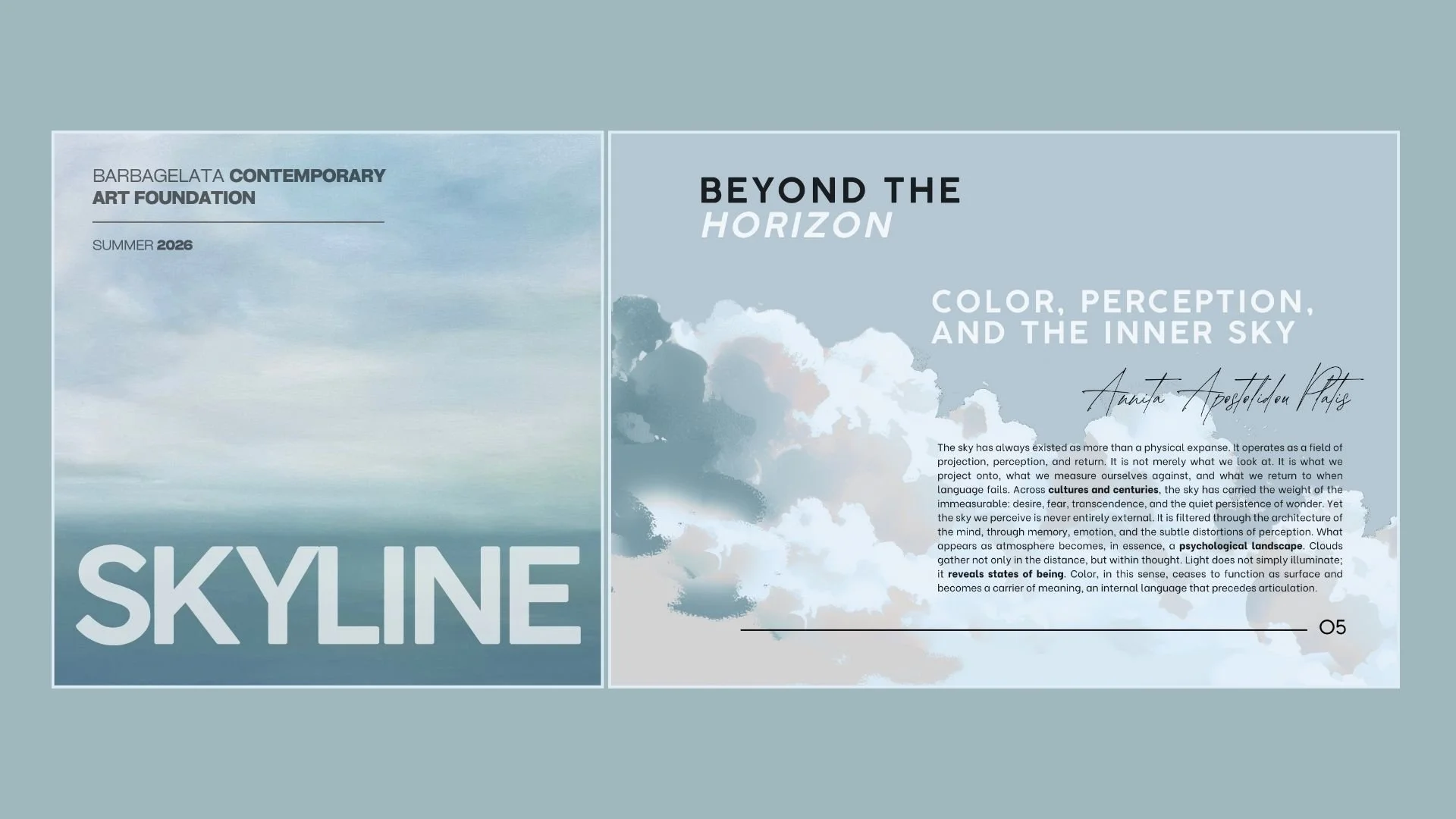
My participation in SKYLINE, the Summer 2026 publication of the Barbagelata Contemporary Art Foundation, became one of those rare experiences. More than presenting artworks within an international publication, it opened a space for reflection—on painting, writing, symbolism, and the invisible dialogue between artistic intuition and philosophical thought.
The publication gathers artists whose practices investigate atmosphere, memory, perception, abstraction, and the emotional language of landscape. Within this broader conversation, my contribution includes three paintings from my series When Color Knows the Script—Blind to Gravity, Where the Cloud Learns My Name, and Suspended Architectures—alongside my essay Beyond the Horizon: Color, Perception, and the Inner Sky, which opens the publication.
To discover that the editorial journey of SKYLINE begins with my text was both an honour and a deeply meaningful gesture. Essays often accompany artworks as contextual reflections; here, writing became the threshold through which readers first entered the publication. It reaffirmed something I have long believed: painting and language are not separate territories, but two complementary ways of exploring perception.
Beyond the Visible Horizon
Throughout my practice, colour has never functioned simply as a visual phenomenon. It is a psychological structure, a symbolic language, and often the first emotional gesture within a painting.
The horizon, likewise, has always interested me less as geography than as possibility. It represents the place where certainty dissolves and imagination begins—a space where memory, intuition, and transformation meet.
Rather than illustrating stories, I attempt to construct visual environments in which viewers may recognize fragments of their own emotional landscapes. Every symbol remains deliberately open, inviting interpretation instead of dictating meaning.
This approach shaped both the paintings and the essay presented in SKYLINE. Writing became another way of navigating the same questions explored on canvas: How does colour alter perception? Where does memory reside? What invisible structures shape our emotional response to images?
Three Works, One Visual Conversation
Although each painting stands independently, together they form a quiet dialogue.
Blind to Gravity explores liberation from inherited limitations, where gravity becomes less a physical force than an emotional condition capable of being transformed.
Where the Cloud Learns My Name reflects upon identity as something fluid rather than fixed. Here, sky and figure dissolve into one another, suggesting that recognition often begins through uncertainty rather than certainty.
Suspended Architectures examines the fragile structures we construct internally—those invisible frameworks of memory, experience, hope, and vulnerability that support our emotional lives while remaining unseen.
Across these works, colour functions as narrative rather than ornament. Symbolism emerges not as illustration but as atmosphere, allowing meaning to unfold gradually through contemplation.
Where Painting Meets Writing
Although painting remains my primary language, writing has increasingly become an essential extension of my artistic practice.
Essays, curatorial reflections, and symbolic texts do not explain my paintings; instead, they continue the conversation initiated by the image. Often, I discover that certain ideas can only be fully explored once both visual and written forms begin speaking to one another.
For me, painting and writing share the same destination. Both seek to transform observation into experience, inviting viewers and readers to move beyond what is immediately visible toward what can only be sensed.
The opportunity to contribute both artworks and an essay to SKYLINE therefore felt entirely natural. It reflected the increasingly interdisciplinary direction of my practice, where image and language coexist as equal forms of artistic inquiry.
A Curatorial Perspective
One of the most unexpected and meaningful aspects of SKYLINE was the opportunity to encounter my work through the curatorial lens of the Barbagelata Contemporary Art Foundation.
Within their editorial reflections, the Foundation drew thoughtful parallels between my artistic language and the philosophical writings of Gaston Bachelard, whose explorations of imagination, memory, poetic space, and the inner life of images have profoundly influenced generations of artists, writers, and thinkers.
Reading Bachelard after discovering these curatorial associations was both an honour and an illuminating experience. Rather than suggesting influence, it offered a new perspective through which to observe questions that had already emerged intuitively within my own practice. It became an invitation to reflect on how different disciplines—painting, writing, philosophy, and curation—can unexpectedly converge around shared ideas while remaining entirely independent in their origins.
For me, this was one of the greatest gifts of participating in SKYLINE. The publication became more than a presentation of artworks; it became an opportunity to see my own artistic journey illuminated through a broader cultural and philosophical dialogue, generously opened by the Foundation's editorial vision.
The Gift of Curatorial Dialogue
Every meaningful publication depends upon dialogue.
What distinguished SKYLINE was not only the careful presentation of the artworks but the editorial willingness to engage with the ideas that generated them.
Alongside my essay, the publication includes the curatorial feature When Color Becomes Consciousness, an editorial reflection exploring the relationship between symbolism, perception, memory, and colour within my practice.
Rather than describing individual paintings, the text considers broader questions concerning artistic language itself. It proposes that colour can become a mode of thinking and that visual experience may function as a philosophical encounter rather than simply an aesthetic one.
As an artist, there are few experiences more rewarding than encountering curatorial writing that does not merely interpret completed works but enters into genuine dialogue with the ideas from which they emerged.
This exchange reminded me that exhibitions and publications achieve their greatest value when they become conversations rather than presentations.
Beyond the Publication
Although every publication eventually reaches its final page, the conversations it begins often continue long afterward.
For me, SKYLINE represents more than an international editorial milestone. It marks a moment in which painting, writing, and curatorial thought converged within a shared space of reflection.
The experience reaffirmed my belief that contemporary artistic practice extends beyond the studio. It unfolds equally through essays, dialogue, philosophy, and the communities that emerge around ideas.
If colour can indeed become consciousness, then perhaps art itself becomes a way of thinking—a means of navigating memory, imagination, and the countless invisible landscapes that shape our lives.
For that, I remain deeply grateful to the Barbagelata Contemporary Art Foundation for creating a publication where images, ideas, and thoughtful dialogue meet with such generosity and care.
Read SKYLINE online
https://heyzine.com/flip-book/c309a54d86.html
Annita Apostolidou Platis
Visual Artist · Curatorial Essayist · Author · Fashion & Jewelry Designer
© 2026 Annita Apostolidou Platis. All rights reserved.