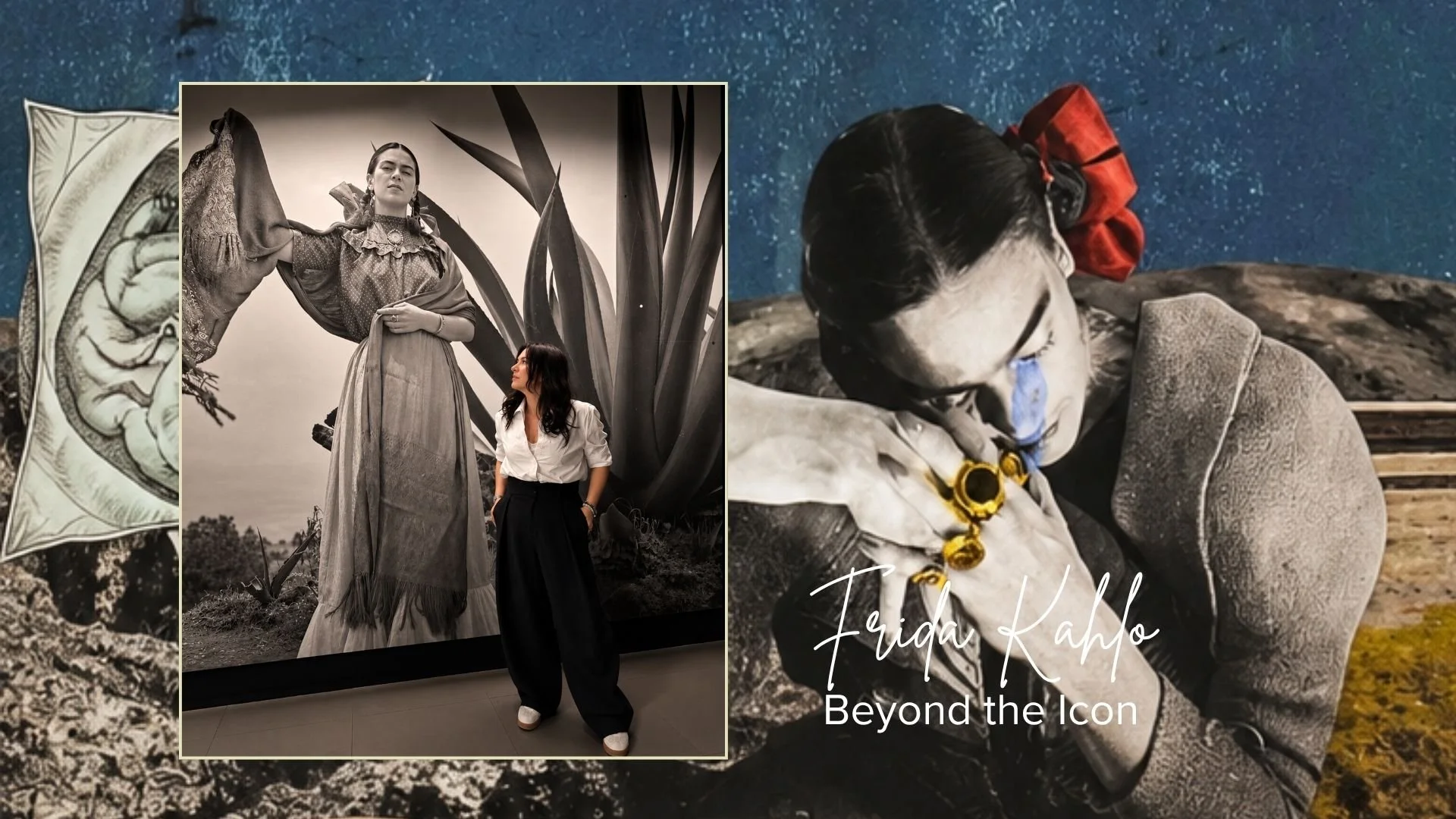
Beyond the Canvas: Frida Kahlo's Enduring Legacy in Contemporary Art
Frida Kahlo: Beyond the Icon inspired this reflection on one of the most influential artists of the twentieth century. Looking beyond the immersive experience itself, this essay explores Kahlo's resilience, symbolic visual language, and the enduring relevance of her work within contemporary art. More than an exhibition review, it is a meditation on authenticity, creativity, and the timeless power of artistic expression.
There are artists whose names become inseparable from the history of art, and there are those whose lives become woven into the very fabric of human resilience. Frida Kahlo belongs to both.
Long before entering Frida Kahlo: Beyond the Icon, I knew I was not simply visiting another exhibition. It was an experience I had anticipated for years—not only because of the immersive technology that promised to reinterpret her world through 360-degree projections, Virtual Reality, and digital media, but because it offered an opportunity to revisit the life of an artist whose influence continues to transcend generations, cultures, and artistic disciplines.
Frida Kahlo is often remembered through the instantly recognizable symbols that have come to define her public image: the flowers woven into her hair, her traditional Tehuana dresses, her unwavering gaze, and her remarkable self-portraits. Yet behind this powerful iconography lies a woman whose artistic language was forged through extraordinary adversity.
At the age of six, Kahlo contracted polio, an illness that left lasting effects on her body. At eighteen, she survived a devastating bus accident that changed the course of her life forever. The injuries she sustained required numerous surgeries over the following decades and left her living with chronic pain for the remainder of her life. Confined to bed during long periods of recovery, she turned toward painting—not as an escape from reality, but as a way of confronting it.
"I paint myself because I am so often alone and because I am the subject I know best," she once wrote.
Her self-portraits were never exercises in vanity. They became visual diaries where identity, memory, love, grief, physical suffering, nature, and mythology converged into a symbolic language unlike any other in twentieth-century art. Rather than concealing vulnerability, Kahlo transformed it into a source of extraordinary creative power.
Perhaps this is why her work continues to resonate so profoundly today.
Frida Kahlo reminds artists that authenticity possesses a timeless strength. In an era increasingly shaped by rapid consumption and constant visual production, her paintings encourage us to slow down and recognise the value of deeply personal expression. She demonstrated that art does not need to imitate beauty to become beautiful; it can emerge from honesty, complexity, contradiction, and emotional truth.
Her influence extends far beyond painting. Writers, photographers, filmmakers, designers, performers, and contemporary visual artists continue to find inspiration in her fearless exploration of identity and the human condition. She challenged conventional representations of femininity long before such conversations entered mainstream cultural discourse, presenting herself neither as an idealised figure nor as a victim, but as a complete human being—strong, fragile, joyful, grieving, defiant, and profoundly alive.
This is what makes Frida Kahlo: Beyond the Icon particularly compelling.
Rather than attempting to replace the original paintings, the exhibition creates an immersive environment where digital technology becomes another language for storytelling. Monumental projections, soundscapes, and Virtual Reality experiences invite visitors to step inside the emotional atmosphere surrounding Kahlo's life and artistic practice. The result is not a substitute for standing before an original work of art, but an invitation to engage with her legacy from a different perspective.
Immersive exhibitions occupy an increasingly significant place within contemporary museum practice. When thoughtfully conceived, they have the capacity to broaden accessibility, encourage emotional engagement, and introduce new audiences to artists whose works remain essential to our shared cultural heritage. Technology, in this context, serves not as spectacle but as a bridge between historical narrative and contemporary experience.
As a contemporary artist, I left the exhibition reflecting less on its technical achievements than on the enduring relevance of Frida Kahlo herself. Every generation encounters different challenges, yet her work continues to remind us that creativity often emerges not from certainty, but from perseverance. The courage to remain truthful to one's inner vision may be one of the greatest acts an artist can perform.
Frida Kahlo's greatest legacy is not merely the extraordinary body of work she left behind, nor the global recognition her image has achieved. It is the reminder that art possesses the remarkable ability to transform personal experience into a universal language. Her paintings continue to speak because they are rooted in something fundamentally human: the desire to understand ourselves, to endure, and to create meaning even in the presence of uncertainty.
More than seventy years after her death, Frida Kahlo remains far more than an icon. She continues to challenge, inspire, and accompany artists around the world, reminding us that every authentic work of art begins with the courage to look inward before speaking to the world.
Perhaps that is why her voice still feels so immediate today.
Not because history remembers her.
But because artists continue to recognize themselves in her unwavering commitment to create.
Annita Apostolidou Platis
Visual Artist · Curator · Essayist · Fashion & Jewelry Designer
© 2026 Annita Apostolidou Platis. All rights reserved.
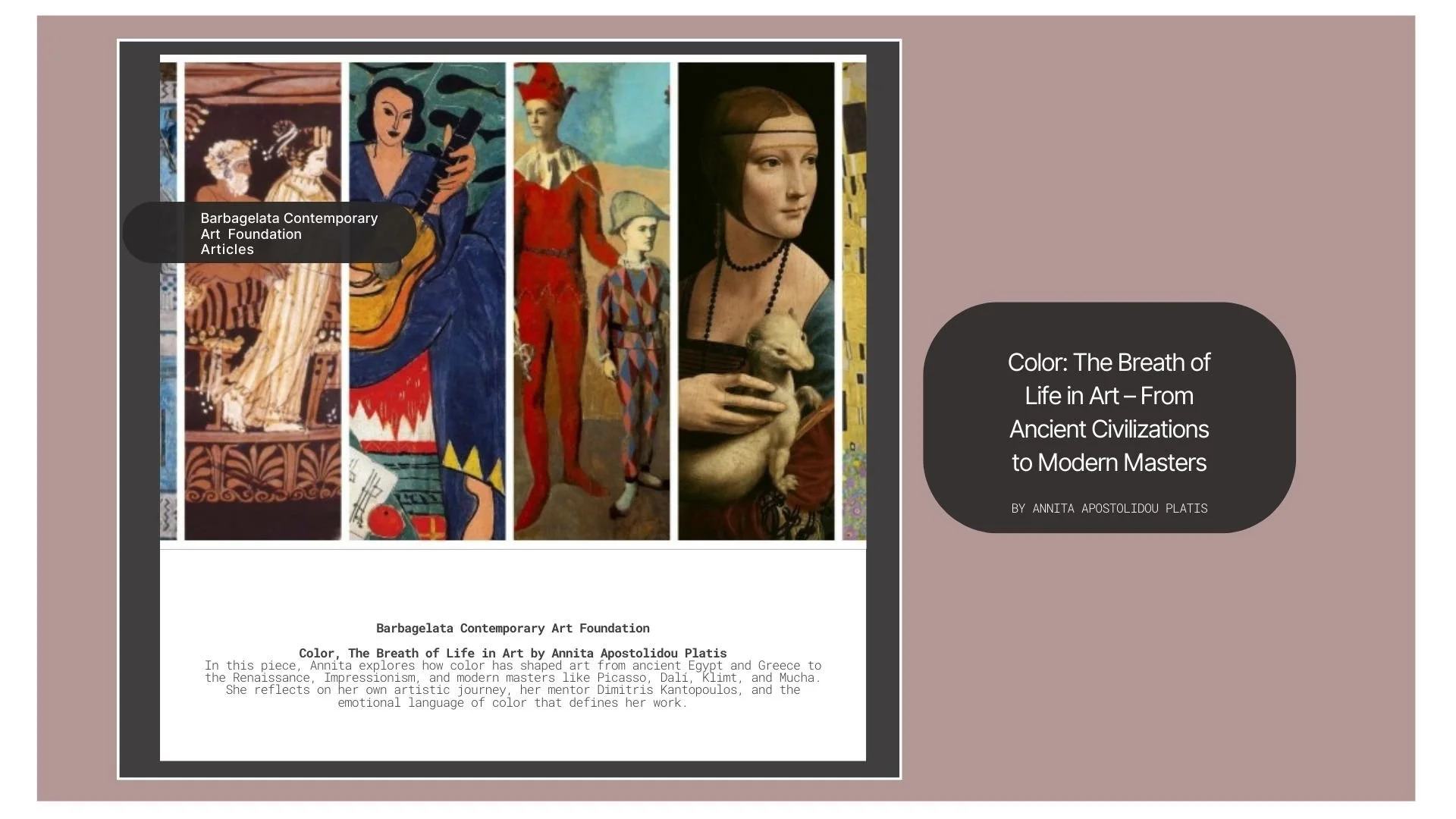
Color: The Breath of Life in Art | Essay by Annita Apostolidou Platis
This essay explores color as a universal language in art, tracing its evolution from ancient symbolic systems to modern artistic expression. Through historical references and personal insight, Annita Apostolidou Platis examines how color conveys emotion, meaning, and visual storytelling across time.
Color: The Breath of Life in Art – From Ancient Civilizations to Modern Masters
Barbagelata Contemporary Art Foundation — Essay Publication (2026)
Color - The Breath of Life in Art
There are moments when writing feels like an extension of painting — when thought, memory, and emotion take form not through image, but through language.
My essay, Color: The Breath of Life in Art – From Ancient Civilizations to Modern Masters, has now been published by the Barbagelata Contemporary Art Foundation.
Originally written in 2025, this text was born from a need to reflect more deeply on color — not only as a visual element, but as a living language. A language that has moved through time, from the sacred symbolism of ancient Egypt and the philosophical inquiries of ancient Greece, to the scientific explorations of the Renaissance and the emotional intensity of modern masters.
Color, for me, has always been more than composition. It is instinct. It is memory. It is the quiet force that carries meaning before words arrive.
Writing this essay allowed me to step outside the image and observe the very element that shapes my artistic identity — to understand it not only through practice, but through history, philosophy, and experience.
I am deeply grateful to the Barbagelata Contemporary Art Foundation for the thoughtful publication and presentation of this work.
© Annita Apostolidou Platis, 2025
Published in 2026 by Barbagelata Contemporary Art Foundation
Annita Apostolidou Platis
Visual Artist · Curator · Essayist · Fashion & Jewelry Designer
© 2026 Annita Apostolidou Platis. All rights reserved.
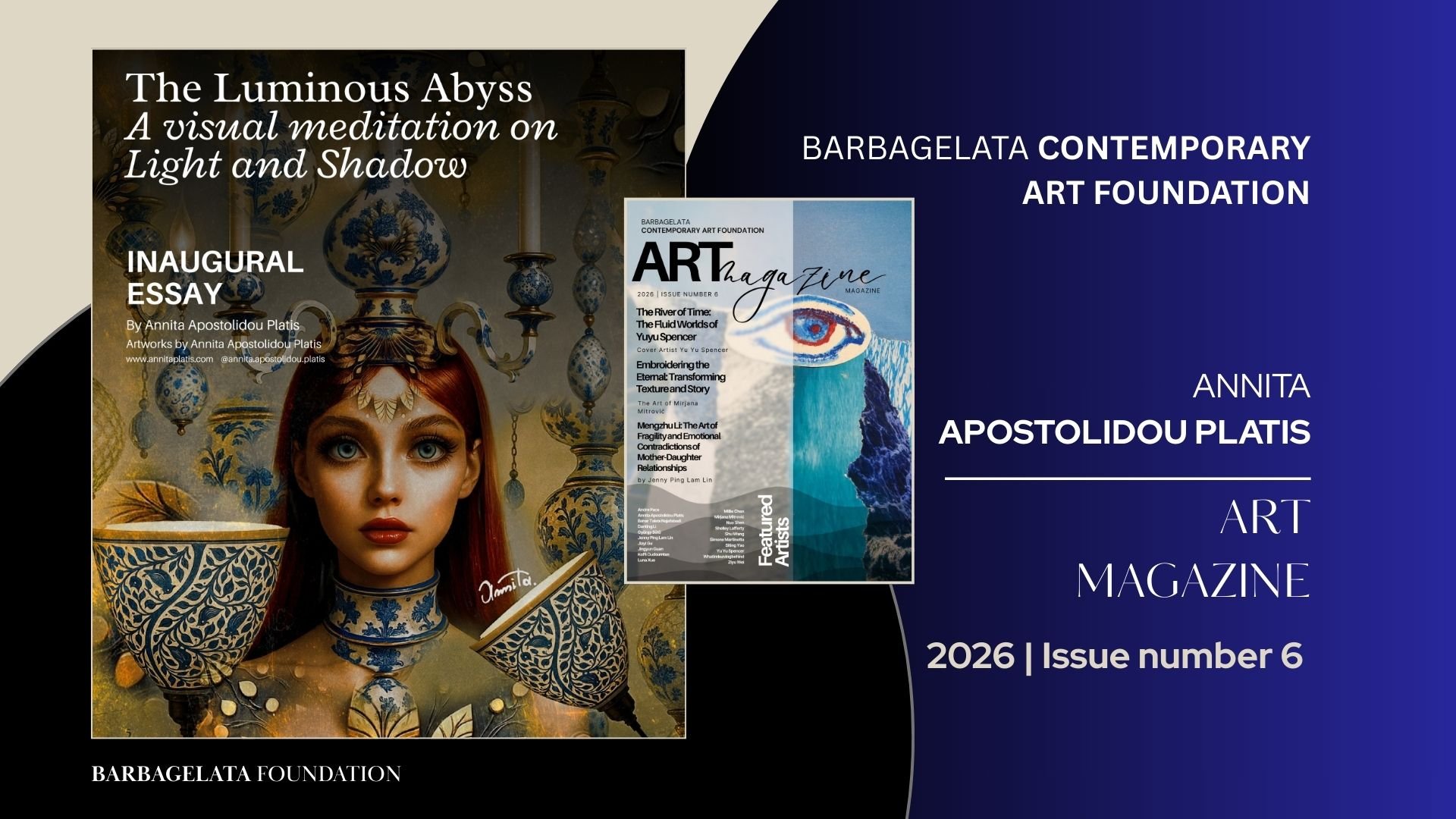
The Luminous Abyss Featured in Art Magazine Issue 6 | Barbagelata Contemporary Art Foundation
The Luminous Abyss explores light not as spectacle but as interior architecture. Featured in Art Magazine Issue 6, this series examines visibility, vulnerability, and symbolic illumination through contemplative female figures suspended between shadow and glow.
The Luminous Abyss
Featured in Art Magazine, Issue 6 – Barbagelata Contemporary Art Foundation (2026)
It is with great appreciation that I share the publication of The Luminous Abyss in Art Magazine, Issue 6 by the Barbagelata Contemporary Art Foundation.
Positioned within the Inaugural Essay section, this feature presents both visual works and reflective writing centered on the relationship between light and shadow — not as aesthetic contrast alone, but as psychological and symbolic structure.
The Luminous Abyss examines illumination as interior architecture. The figures within the series do not perform for the viewer; they observe. They stand between worlds — suspended between revelation and protection — embodying the emotional dualities that define contemporary existence: visibility and secrecy, strength and vulnerability, memory and transformation.
Across the works featured in the publication — including Whispers Through Beads, The Golden Witness, The Vessel Remembers, and The Soft Unknown — light functions as metaphor rather than decoration. Chandeliers, porcelain forms, metallic surfaces, and layered textures become carriers of emotional resonance. Illumination does not dominate; it reveals.
The creative process behind this body of work begins with hand-drawn sketches that evolve into digitally layered compositions. Each element is selected not for spectacle, but for symbolic coherence. The women portrayed operate as vessels of memory and ritual — quiet presences that invite inward reflection.
To see this series presented within an international publication dedicated to contemporary artistic dialogue is deeply meaningful. I extend sincere gratitude to the editorial team of the Barbagelata Contemporary Art Foundation for their thoughtful curation and for fostering spaces where visual language and critical reflection coexist.
The digital edition is now available, with print copies accessible through the Foundation.
Art Magazine
Print Copy
Annita Apostolidou Platis
Visual Artist · Curator · Essayist · Fashion & Jewelry Designer
© 2026 Annita Apostolidou Platis. All rights reserved.