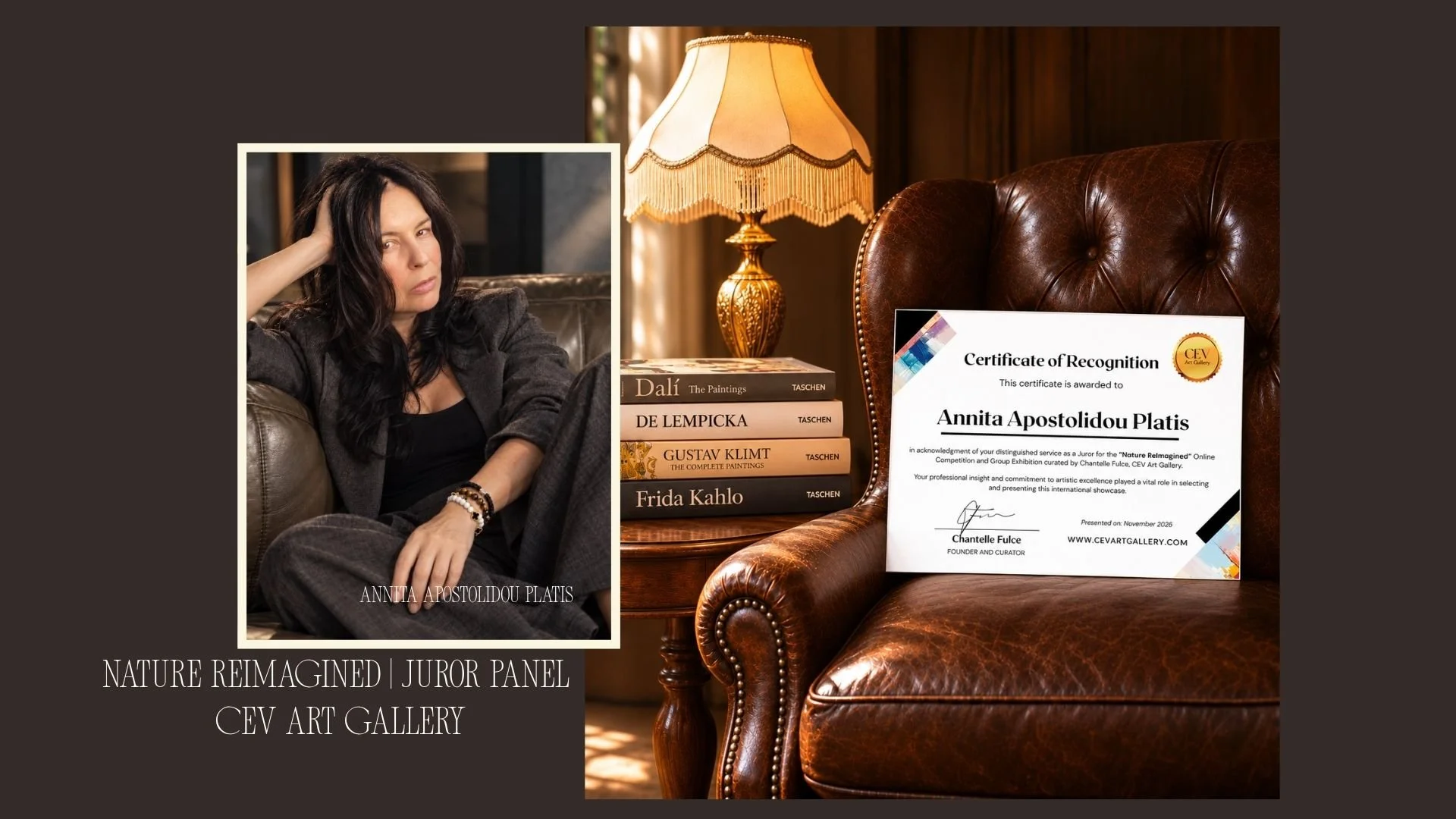
Nature ReImagined 2026 | CEV Art Gallery Juror – Annita Apostolidou Platis
Nature has long inspired artistic expression, yet its interpretation extends far beyond what the eye observes. Reflecting on my participation as a juror for CEV Art Gallery's Nature ReImagined exhibition, I explore how artists transform the natural world through imagination, symbolism, and diverse creative approaches, revealing the relationship between observation, personal experience, and artistic vision.
Throughout the history of art, nature has been both a source of inspiration and a mirror of human perception. From the earliest representations of landscapes, animals, and botanical forms to contemporary explorations of environmental change and imagined ecosystems, artists have continually returned to the natural world—not merely to reproduce its visible appearance, but to interpret its presence, rhythms, and mysteries.
Nature is never entirely separate from the person observing it. What we perceive is influenced by memory, emotion, cultural experience, and the imagination. A landscape may evoke tranquility or uncertainty; a fragment of the natural world may become a symbol of transformation, resilience, or the passage of time.
It is within this relationship between observation and interpretation that Nature ReImagined, the international online competition and juried exhibition presented by CEV Art Gallery, finds its particular relevance.
Nature as an Artistic Language
The natural world offers an extraordinary vocabulary of forms, colors, textures, and movements. Yet artistic interpretation begins when these elements move beyond their physical appearance and become part of a personal visual language.
A familiar landscape may be transformed through unexpected color relationships, while an organic form may acquire symbolic significance. Other interpretations may emerge through abstraction, conceptual exploration, or the imaginative reconstruction of natural environments.
In this sense, nature becomes more than a subject. It becomes a point of departure—a space where artistic observation meets personal experience and creative invention.
What makes this relationship particularly compelling is that the same natural element can inspire entirely different responses. The distinction lies not necessarily in the subject itself, but in the sensitivity, intention, and perspective of the artist.
Different Disciplines, Shared Inspiration
One of the most engaging aspects of serving on the Juror Panel for Nature ReImagined was encountering the diversity of artistic approaches represented in the submissions.
Painting, photography, digital art, and sculpture offered different possibilities for exploring the natural world, each shaped by its own techniques, materials, and expressive qualities.
Some works approached nature through careful observation, emphasizing light, atmosphere, structure, and detail. Others moved toward symbolic interpretation, abstraction, or imaginative transformation, inviting the viewer to experience nature beyond its recognizable appearance.
This diversity highlighted an essential consideration in the jurying process: artistic quality cannot be measured through the expectations of a single medium.
A photograph, a painting, and a sculpture may communicate through very different visual languages, yet each can demonstrate originality, conceptual depth, technical understanding, and a distinctive artistic vision.
The responsibility of the juror is therefore not to privilege one form of expression over another, but to approach each work with openness, consistency, and respect for its individual creative intention.
Between the Visible and the Imagined
The title Nature ReImagined suggests something beyond representation. To reimagine nature is not necessarily to depart from reality, but to discover possibilities within it that might otherwise remain unnoticed.
Art allows us to reconsider the familiar. Through changes in scale, perspective, composition, material, or symbolic association, the natural world can become a landscape of memory, emotion, and imagination.
A form drawn from nature may suggest vulnerability or strength. A landscape may become an expression of solitude, renewal, or belonging. Even the smallest natural detail can acquire significance when interpreted through an artist's personal experience.
Such transformations remind us that artistic imagination does not exist in opposition to observation. Rather, the two can enrich one another, allowing what is visible to become the foundation for something more deeply felt or intellectually explored.
For me, this dialogue between the tangible and the imagined was among the most interesting aspects of the exhibition's theme.
Curatorial Reflection and Recognition
Serving as a juror for Nature ReImagined formed another chapter in my continuing collaboration with CEV Art Gallery and its Founder and Curator, Chantelle Fulce.
The evaluation process offered an opportunity to engage with a broad range of artistic perspectives while considering thematic relevance, originality, execution, conceptual depth, and overall visual impact.
I am grateful to Chantelle Fulce and CEV Art Gallery for their continued trust in my contribution to the jury process and for the Certificate of Recognition acknowledging my participation.
Nature ReImagined is presented online from November 9, 2026, through January 31, 2027.
A Continuing Dialogue with Nature
Perhaps one of art's most enduring qualities is its ability to reveal new dimensions within what we believe we already know.
Nature surrounds us, yet our relationship with it is never entirely fixed. It changes through experience, memory, discovery, and the passage of time.
Through artistic interpretation, the natural world becomes a place where observation and imagination meet, where familiar forms acquire unexpected meanings, and where individual perspectives open new possibilities for understanding.
Nature ReImagined reminds us that the act of seeing is only the beginning. What follows is the artist's capacity to transform perception into expression—and to invite others to encounter the world through a different vision.
Annita Apostolidou Platis
Visual Artist · Curatorial Essayist · Fashion & Jewelry Designer
© 2026 Annita Apostolidou Platis. All rights reserved.

Abstract Art: Beyond Representation — Reflections on Jurying an International Exhibition
Beyond recognizable imagery, abstract art offers a visual language shaped by emotion, gesture, color, and artistic intention. Reflecting on my participation as a juror for CEV Art Gallery's Abstract Art 2026 exhibition, I explore the relationship between creative freedom, visual expression, and the possibilities of abstraction in contemporary art.
Abstraction begins where representation ceases to be a necessity.
Throughout the evolution of modern and contemporary art, abstraction has challenged the boundaries of visual expression, liberating artistic creation from the obligation to reproduce the visible world. Rather than depicting recognizable subjects, abstract art invites us to encounter color, form, gesture, texture, and space as independent carriers of meaning.
Yet abstraction is not simply the rejection of representation. It is the exploration of another visual language—one capable of communicating emotion, memory, movement, and psychological experience without relying on familiar imagery.
This relationship between freedom and intention formed the conceptual foundation of the Abstract Art Online Competition & Juried Exhibition, presented by CEV Art Gallery, for which I served as a member of the gallery's Juror Panel in 2026.
The exhibition invited artists to explore abstraction through diverse media and individual approaches, emphasizing contrast, emotion, storytelling, and the possibilities of creative expression beyond conventional artistic boundaries.
With submissions from 91 artists and 257 artwork entries, the competition offered an extensive encounter with contemporary abstract practices, bringing together participants representing six countries.
The Language of Abstraction
One of the most compelling qualities of abstract art lies in its capacity to communicate without offering a predetermined narrative.
A composition may evoke tension through opposing colors, establish harmony through repetition, or suggest movement through gestural marks and shifting spatial relationships. What appears spontaneous may result from a carefully considered artistic process, while seemingly simple arrangements can reveal unexpected complexity.
In abstraction, the absence of recognizable imagery does not necessarily imply the absence of meaning.
On the contrary, it often creates space for a more personal encounter between the artwork and its viewer.
Unlike representational art, where familiar subjects may provide an immediate point of reference, abstraction asks us to engage with the visual experience itself. Color becomes atmosphere, form becomes movement, and composition develops its own internal rhythm.
This openness allows abstract works to generate different interpretations without requiring a single definitive reading.
However, artistic freedom does not automatically guarantee artistic strength.
The challenge lies in transforming visual experimentation into a compelling and coherent expression—one in which formal decisions, whether deliberate or intuitive, contribute meaningfully to the artwork's identity.
Between Freedom and Artistic Intention
The exhibition's invitation to explore abstraction without conventional restrictions raised an interesting question: What gives an abstract artwork its artistic presence when recognizable subject matter is no longer the central consideration?
For me, the answer lies partly in the relationship between freedom and intention.
An abstract composition need not follow established rules of balance, proportion, or harmony. It may challenge them entirely. Yet its visual elements must establish a relationship capable of sustaining attention and communicating an individual artistic perspective.
During the jury process, this distinction became particularly significant.
The evaluation of abstract works requires sensitivity to different artistic intentions and an understanding that technical precision is not always the defining measure of accomplishment.
A spontaneous gestural painting, a carefully constructed geometric composition, and an experimental mixed-media work may each possess artistic strength for entirely different reasons.
What matters is not their adherence to a particular aesthetic, but the effectiveness with which their visual language communicates.
Originality, conceptual coherence, composition, material exploration, and visual impact therefore become important considerations, always understood in relation to the artist's chosen approach.
Equally important is the ability to recognize that abstraction can be expressive without being dramatic, restrained without being empty, and complex without relying on excessive visual information.
Its strength often emerges from the relationship between what is presented and what is deliberately left unresolved.
A Dialogue Beyond the Visible
As a visual artist whose own practice frequently explores symbolism, emotional transformation, and the relationship between traditional and digital media, I find the language of abstraction particularly interesting.
Although my work often incorporates recognizable figures and symbolic elements, the expressive possibilities of color, composition, and visual atmosphere remain central to my artistic vocabulary.
Encountering abstraction through the jury process offered another perspective on these elements, allowing me to consider how artists construct meaning when representation is reduced, transformed, or abandoned altogether.
It also highlighted the remarkable diversity that exists within contemporary abstract practice.
Some works communicate through energetic gestures and chromatic intensity. Others rely on restraint, subtle tonal relationships, or the quiet interaction of forms.
Each approach invites a different kind of attention.
Ultimately, abstraction reminds us that art does not always need to describe something recognizable to communicate something deeply felt.
Sometimes, its most compelling quality is precisely its refusal to explain everything.
Recognition and Continuing Collaboration
Following the completion of the jury process, I was pleased to receive a Certificate of Participation from CEV Art Gallery, acknowledging my contribution as a Juror for the Abstract Art Online Competition & Juried Exhibition.
The exhibition, featuring 209 artworks by 30 selected artists, opened on September 28, 2026, and continues through November 30, 2026.
I extend my sincere appreciation to Chantelle Fulce, Founder and Curator of CEV Art Gallery, for her continued trust and for the opportunity to contribute to another international exhibition.
My ongoing involvement with the gallery's jury program remains an important aspect of my professional engagement with contemporary artistic practices, offering opportunities to encounter diverse creative perspectives and participate in the critical evaluation of visual art.
Abstract Art ultimately invites us to reconsider the boundaries between what we see and what we experience.
Beyond recognizable subjects and established visual conventions, abstraction offers a space in which imagination, emotion, and artistic intention can coexist without the necessity of explanation.
Perhaps its greatest freedom lies not in the absence of rules, but in the possibility of discovering an entirely personal language through which to express the intangible.
Annita Apostolidou Platis
Visual Artist · Curatorial Essayist · Fashion & Jewelry Designer
© 2026 Annita Apostolidou Platis. All rights reserved.

Animal Kingdom: Instinct, Symbolism and the Contemporary Gaze - Jurying an International Exhibition
From observation and realism to symbolism and metaphor, Animal Kingdom revealed the enduring presence of animals within contemporary visual culture. A reflection on my jury experience with CEV Art Gallery and the many artistic interpretations encountered throughout the exhibition.
Animals have occupied the human imagination since the earliest forms of visual expression. They appear across cultures as companions and protectors, symbols of power and vulnerability, embodiments of instinct, and figures through which we often project something of ourselves.
This enduring relationship provided the context for Animal Kingdom, the Online Competition & Group Exhibition presented by CEV Art Gallery, for which I had the pleasure of serving as a member of the gallery's Juror Panel in 2026.
What made the experience particularly engaging was the breadth of interpretation within a seemingly familiar subject. The animal figure can be approached through observation and realism, transformed through abstraction, invested with symbolic meaning, or used as a vehicle for narratives extending far beyond the natural world itself.
Within this diversity, the task of evaluation became one of recognizing intention. A technically accomplished representation can command attention through precision and sensitivity, while another work may derive its strength from atmosphere, gesture, unexpected composition, or the transformation of a recognizable creature into something psychological or metaphorical.
For me, this was one of the most interesting aspects of Animal Kingdom: seeing how individual artists moved beyond the simple depiction of an animal to establish a distinctive relationship between subject, medium, and artistic voice.
Looking Beyond the Subject
A strong thematic exhibition is not created merely by assembling works that correspond literally to its title. The theme provides a point of departure; what matters is what the artist does with it.
During the jury process, I therefore found it important to consider how convincingly each work developed its own visual identity. Originality, artistic quality, technical execution, emotional presence, and connection to the exhibition concept all contributed to the broader assessment.
The experience also reinforced something fundamental to jury work: very different artistic languages must be allowed to exist on their own terms. A photograph cannot be approached as a painting, nor should a highly detailed figurative work automatically be privileged over an experimental or conceptual interpretation. Each requires attention to what it sets out to achieve and how successfully its chosen language supports that intention.
A Continuing Collaboration
Following the completion of the exhibition process, I was honored to receive a Certificate of Participation from CEV Art Gallery, in acknowledgment of my service as a Juror for Animal Kingdom.
The recognition holds particular meaning within my continuing collaboration with the gallery, as my participation in its jury program has allowed me to encounter an increasingly broad spectrum of contemporary practices and artists from different backgrounds.
I would like to thank Chantelle Fulce, Founder and Curator of CEV Art Gallery, for her continued trust and for recognizing my contribution to the jury process.
Animal Kingdom ultimately reminded me of why the animal presence remains so persistent within art. Animals allow us to look outward toward nature while simultaneously turning inward—toward instinct, memory, emotion, mythology, vulnerability, and identity.
Perhaps this is why they continue to fascinate artists across generations: we observe them, interpret them, transform them into symbols—and, somewhere within that process, inevitably reveal something about ourselves.
Annita Apostolidou Platis
Visual Artist · Curatorial Essayist · Fashion & Jewelry Designer
© 2026 Annita Apostolidou Platis. All rights reserved.

Continuing My Curatorial Journey: Jurying the Chromatic International Exhibition
Serving as a juror for Chromatic reinforced my belief that thoughtful evaluation is an essential part of curatorial practice. This reflection explores the responsibility of jurying contemporary art and the value of engaging with diverse international artistic voices.
Every exhibition presents a different conversation.
As artists, we speak through images. As jurors, we are invited to listen carefully to those visual voices, to understand their intentions, and to evaluate them with fairness, consistency, and respect.
I recently had the opportunity to contribute once again as a member of the CEV Art Gallery Juror Panel, participating in the evaluation of artworks for the Chromatic Online Competition & Juried Exhibition. This marked my second completed exhibition with the gallery and further strengthened my commitment to curatorial practice alongside my work as a visual artist and essayist.
Unlike exhibitions defined by subject matter, Chromatic invited artists to explore one of the most expressive elements of visual language: color. Across a wide range of media and artistic approaches, each submission demonstrated a personal understanding of how color can shape atmosphere, communicate emotion, construct symbolism, and guide perception.
Evaluating these works required more than identifying technical accomplishment. It demanded careful consideration of originality, conceptual coherence, visual impact, and the relationship between color and meaning. Every artwork represented an individual creative journey, deserving thoughtful attention regardless of style or medium.
Serving as a juror continues to deepen my appreciation for the dialogue that exists between artistic creation and curatorial responsibility. While artists construct visual narratives, jurors help shape the conversation that unfolds within an exhibition. The role is not to define artistic value through personal preference, but to recognize works that communicate with clarity, authenticity, and integrity while contributing meaningfully to the exhibition as a whole.
I am sincerely grateful to Chantelle Fulce, Founder and Curator of CEV Art Gallery, for her continued trust and for the opportunity to contribute to another international exhibition. Collaborating with fellow jurors while engaging with such a diverse body of contemporary work has been both professionally rewarding and intellectually enriching.
As my curatorial journey continues, I remain committed to supporting artistic excellence through thoughtful evaluation, critical reflection, and meaningful dialogue. Each exhibition expands not only my understanding of contemporary art but also my conviction that careful curation plays an essential role in connecting artists with audiences across cultures and creative disciplines.
The completion of Chromatic represents another meaningful step within this ongoing journey—one that continues to unite my practices as a visual artist, curatorial essayist, and juror through a shared commitment to the transformative power of art.
Annita Apostolidou Platis
Visual Artist · Curatorial Essayist · Fashion & Jewelry Designer
© 2026 Annita Apostolidou Platis. All rights reserved.

Serving on the Jury Panel for CEV Art Gallery's Luminous International Exhibition
Annita Apostolidou Platis was honored to serve as a member of the jury panel for CEV Art Gallery's Luminous Online Competition & Juried Exhibition. The appointment reflects her expanding role within the international contemporary art community, contributing professional insight to the evaluation of artworks from artists across multiple countries.
Professional practice within the arts extends beyond the creation of artwork itself. It also involves engaging with the broader artistic community through curatorial dialogue, critical evaluation, and the thoughtful recognition of creative excellence.
It was an honor to serve as a member of the jury panel for the Luminous Online Competition & Juried Exhibition presented by CEV Art Gallery, contributing to the evaluation of an international collection of contemporary artworks exploring the theme of light.
Curated by Chantelle Fulce, Luminous brought together artists working across a wide range of media, each interpreting illumination through their own visual language. Reviewing the submissions offered the opportunity to engage with diverse artistic voices, approaches, and conceptual perspectives while considering originality, technical execution, visual impact, and the expressive role of light within each work.
Participating as a juror represents an important extension of my artistic practice. Alongside painting, writing, and curatorial research, jury service encourages a deeper reflection on contemporary artistic dialogue and the responsibilities involved in evaluating creative work with fairness, openness, and respect for individual expression.
I am sincerely grateful to Chantelle Fulce and CEV Art Gallery for their trust and for the opportunity to contribute to this international exhibition. My congratulations go to all participating artists and award recipients whose dedication and creativity helped shape a remarkable showcase of contemporary art.
I look forward to future opportunities to contribute to CEV Art Gallery's exhibition program and to continuing meaningful collaborations that support artists and encourage thoughtful engagement with contemporary visual culture.
Annita Apostolidou Platis
Visual Artist · Curatorial Essayist · Fashion & Jewelry Designer
© 2026 Annita Apostolidou Platis. All rights reserved.

Annita Apostolidou Platis Joins Juror Panel of CEV Art Gallery (2026)
Annita Apostolidou Platis joins the 2026 Juror Panel of CEV Art Gallery, expanding her role as a visual artist and curatorial essayist into the evaluation of international contemporary art.
In 2026, Annita Apostolidou Platis joins the Juror Panel of CEV Art Gallery, contributing her curatorial perspective to the evaluation and selection of international exhibitions, beginning with Luminous.
This appointment marks a significant extension of her multidisciplinary practice as a visual artist, writer, and curatorial essayist. Known for her symbolic language, chromatic sensitivity, and narrative-driven compositions, her work has consistently explored themes of transformation, mythology, and feminine identity. Through this role, she engages with contemporary artistic practices from a curatorial standpoint—approaching each work through its conceptual depth, visual structure, and emotional resonance.
Her participation in the jury process reflects an evolving dialogue between artistic creation and curatorial interpretation. Drawing from her background in exhibition writing and thematic development, she contributes to the evaluation of artworks through a lens shaped by symbolism, color theory, and narrative coherence.
The exhibition Luminous, scheduled for 2026, brings together international artists exploring light, illumination, and visual intensity across diverse media. As part of the juror panel, Annita Apostolidou Platis participates in the selection process, supporting the recognition of works that demonstrate originality, clarity of vision, and a strong conceptual presence.
This role further reinforces her position within contemporary visual culture—not only as an exhibiting artist and published author, but as a contributor to curatorial discourse and artistic evaluation on an international level.
Annita Apostolidou Platis
Visual Artist · Curatorial Essayist · Fashion & Jewelry Designer
© 2026 Annita Apostolidou Platis. All rights reserved.